
AFCON is One of Africa's Longest-Running Cultural Productions

Updated: Jan 7
AFCON operates like cinema: recurring characters, inherited rivalries, rising stars, and moments that gain meaning over time. For more than six decades, African football has unfolded as long-form storytelling, where nations perform identity and players become myth.

Why Africa's Biggest Tournament is also its Greatest Story
For many in the diaspora international audience, football loyalty often begins and ends with European leagues or global mega-sports events. As such, the African Cup of Nations (AFCON) can feel distant or under-contextualized. But that distance has less to do with relevance and more to do with how the story has been told.
This week, as Nigeria crushed Mozambique 4-0 with Victor Osimhen, one of football's top talents, scoring twice, and Egypt's Mohamed Salah delivered a 120th-minute winner to beat Benin 3-1 in extra time, AFCON 2025 reminded the world why it remains one of the continent's most enduring cultural productions. Cameroon's three-week-old assembled team edged South Africa 2-1 in a dramatic encounter to set up a heavyweight quarterfinal clash with hosts Morocco, while defending champions Senegal, Mali, and tournament favorites Morocco have all secured their places in the final eight.

The players dominating this tournament read like a who's who of global football royalty: Osimhen, the masked goal machine and 2023 African Footballer of the Year. Salah, Liverpool's Egyptian king, is chasing his first AFCON title after two heartbreaking finals. Real Madrid's Brahim Díaz is orchestrating Morocco's title charge on home soil. Manchester United's Amad Diallo, the only player to win two Man of the Match awards in the group stage. And even Kylian Mbappé watched in person, captivated by football that refuses to be packaged into neat, European narratives.
This is AFCON. And if you've been sleeping on it, you're missing the greatest unscripted series on earth.
AFCON Is Not New, Not Marginal, and Certainly Not Secondary.
Founded in 1957, AFCON predates the independence of dozens of African nations. Long before Nollywood, before satellite television, before global streaming platforms, AFCON was already functioning as a pan-African broadcast system, one of the earliest recurring spaces where the continent saw itself reflected, contested, and unified in public view.
The history of the Africa Cup of Nations mirrors Africa’s political and social evolution. The earliest editions were intimate by design: the inaugural 1957 tournament featured just Egypt, Ethiopia, and Sudan; a small field reflecting a continent still under colonial rule. As the wave of independence swept across Africa in the 1960s and 1970s, newly sovereign nations entered AFCON not merely to compete, but to announce their presence on the world stage. Football became a form of diplomatic language. A flag raised before kickoff, an anthem played to an international audience, a victory broadcast beyond borders, these moments mattered. Over time, participation expanded alongside statehood, transforming AFCON from a modest regional contest into a continental arena where identity, pride, and political visibility were contested in real time. In this way, AFCON helped narrate Africa’s becoming. Victories mattered because they were symbolic. Losses hurt because they were public.
Certain nations like Egypt, with their historic continental-based-players-led dominance and Cameroon, with their golden eras, have emerged as repeat winners, creating rivalries and expectations that span generations. These are long-running narrative arcs, the same raw material that fuels epic cinema.

Behind the Lens: AFCON as Major Production
What most viewers don't see is the massive production operation behind every AFCON match. According to French broadcaster RMC Sport, AFCON 2025 employs around thirty cameras per stadium, plus drones and high-quality directing, filmed like a European Championship match.
In film language, that's 30 different angles captured simultaneously. Squeeze-back camera operators positioned behind the goals. Aerial cinematographers piloting drones. A gaffer managing stadium lighting to ensure broadcast quality across nine venues in six Moroccan cities. A live-switch director in the production truck makes split-second decisions about which emotion the world sees: the player's celebration, the coach's reaction, the fan's tears.
Each match activates a cast and crew in the hundreds: Broadcast directors and camera operators; replay technicians and sound engineers; drone pilots and visual effects teams; commentators, translators, photographers; stadium crews, security, and medical staff; digital media teams, advertisers, and brand activators. Millions of dollars are spent on broadcast rights and transmission, stadium upgrades, temporary infrastructure, travel, accommodation, security, media operations, and global distribution.
AFCON is industrial-scale media production: a continent-wide operation backed by title sponsor TotalEnergies (hence the official name: TotalEnergies CAF AFCON), alongside global partners like TECNO (Official Global Partner), PUMA (official match ball), and Morocco’s national railway ONCF as an Official Sponsor.
Layered onto that are pan-African and global commercial partners; telcos, betting, transport, consumer tech, and tourism brands buying into AFCON as premium global inventory. The rotating Visit Morocco stadium LED perimeter takeovers, comparable to Visit Rwanda’s Premier League integrations. Premium nation-branding plays, calibrated for hundreds of millions of viewers across broadcast, streaming, and social.
So, when we talk about AFCON, we are talking about a different production philosophy. And the numbers and spectacle all prove it. For instance, Sports Business in Africa reported in September 2025 that brands spent roughly $75 million on sponsorship for the 2023 edition of the tournament. That has almost doubled as beIN SPORTS reported a stunning $126.2 million for this year’s instalment. That’s without accounting for the long-term economic benefits for the host nation, among other beneficiaries.
The Economics of Spectacle
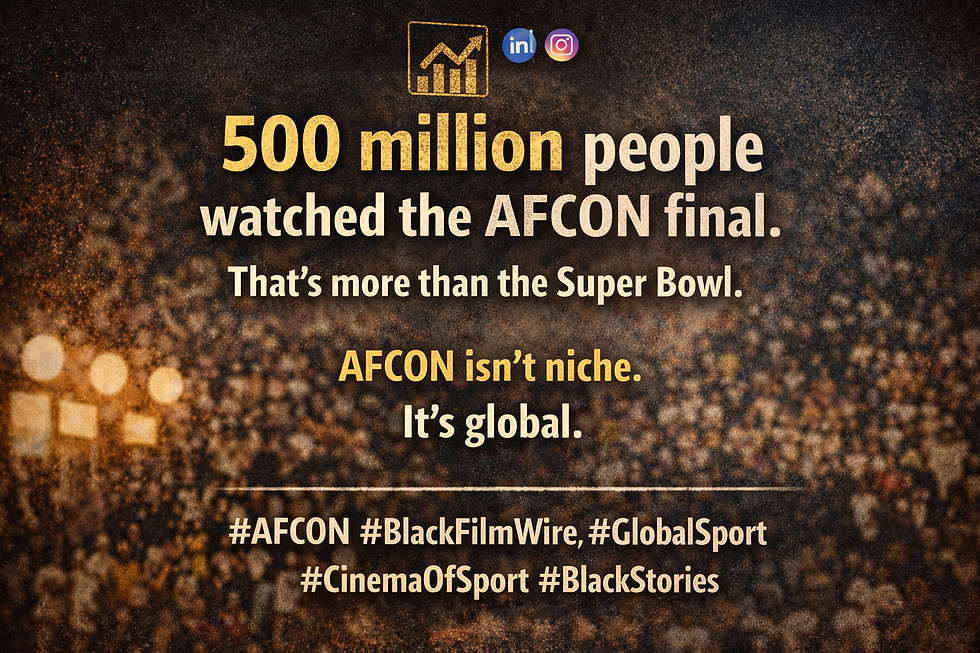
To understand AFCON's scale, consider the advertising comparison: A 30-second commercial during the 2025 Super Bowl costs approximately $8 million, with total game advertising revenue reaching hundreds of millions of dollars. While AFCON's advertising figures aren't publicly disclosed at Super Bowl levels, the tournament has secured a record 20 media rights partnerships across over 30 European territories, plus broadcast deals across Africa, the Americas, and Asia. Over 500 million viewers watched the 2024 AFCON final. This is a global broadcast event with hundreds of millions in infrastructure investment, rights fees, and brand partnerships.
The 2024 AFCON reportedly drew a total global audience of over 1.4 billion viewers across the tournament, with specific matches spiking significantly. YouTube. Other reports, such as Semafor’s put AFCON’s overall viewership as high as 2 billion viewers worldwide.
In contrast, the FIFA World Cup remains the world’s most-watched sporting event by a wide margin, with around 5 billion viewers over the full tournament and approximately 1.5 billion tuning in for the final match. The Super Bowl is one of the biggest annual live broadcasts in the U.S., with the 2025 game drawing about 127.7 million total viewers, most of them in the U.S. (with only a modest international share), according to Reuters. By comparison, even top-tier global events like the Euros or UEFA Champions League finals draw hundreds of millions globally but still lag well behind the World Cup and major soccer tournaments, according to AS USA.
Morocco alone has invested heavily in tournament infrastructure, including stadium upgrades, transportation networks, and media facilities spending, that sparked domestic protests but underscores the economic weight of hosting. Its broadcast footprint (Europe, Africa, Americas, Asia) situates it among the largest recurring international sporting media events in the world, even if not every global viewer watches every match.
In a world where the Super Bowl's biggest audience is 127 million (primarily U.S.) and the Champions League final sits in the 400 million range, AFCON's cumulative tournament reach in the billions signals a massive global engagement that many diaspora viewers simply haven't been told about yet.
Great Cinematic Moments: When Sport Becomes Art
This tournament has given us Michel Kuka Mboladinga, known as "Lumumba Vea," a 53-year-old Congolese supporter who stands perfectly motionless for 90+ minutes in a blue suit, yellow blazer, and red trousers, the colors of DR Congo's flag, recreating the iconic statue of Patrice Lumumba, the country's assassinated first prime minister.
Television cameras found him dressed in a striking outfit, standing firm with his right hand raised in salute, not moving an inch throughout the entire match. In DR Congo's opening game against Senegal, Lumumba Vea stood motionless throughout, deliberately mirroring the statue of the country's independence leader, an act striking in its simplicity yet powerful in its meaning. This is the kind of visual storytelling you cannot script. A live performance art piece embedded in a football match. A political statement. A memorial. An act of resistance happening in real time on a global stage. All of this and then more.


For readers more familiar with basketball, American football, or Formula One, it helps to think of football and AFCON specifically through a cinematic lens. There are protagonists and antagonists, like Ghana and Nigeria, who have a fun longstanding footballing beef. Stakes and turning points like with the current Mozambique squad who made their first AFCON Knockout round in history. Underdog arcs like Sudan’s. And triumph, tragedy, and legacy, best exemplified by Mohammed Salah’s treatment coming into this tournament.
This is why football has inspired films across cultures. Pictures like Bend It Like Beckham and Goal!, and documentaries on global icons, resonate beyond fans. Africa has produced legendary figures whose stories transcend the pitch. Roger Milla, whose joy, longevity, and defiance of age redefined African excellence on the world stage. And globally, football mythology has been shaped by figures like Pelé, whose Afro-diasporic legacy helped define how the world told football stories. These figures matter because they represent something larger.
Why AFCON Matters to the Global Black Audience

AFCON is not competing with the Champions League, the NBA Finals, the Super Bowl, the Cricket World Cup, or any other tourney. It is doing something different by offering: football where history, language, and postcolonial reality shape every narrative; stories that refuse simplification; a reminder that sport can still be culturally consequential; and one of the most enduring storytelling platforms Africa has ever built.
Like all great stories, AFCON deserves context because it helps in understanding Africa better.
And that is why it matters.
This is the first in a series of Black Film Wire editorials covering the 2025 Africa Cup of Nations through the lens of cinema, culture, and storytelling. Join us as we move from quarterfinals to semifinals to the final, watching not just who wins, but what the winning means.


Comments