
Love Is Blind Season 10: Casting Optics, Edit Architecture, and the Audience Anthropology of a Maturing Franchise

Netflix’s Love Is Blind entered its tenth U.S. installment in Ohio carrying a familiar paradox: a new location, but narrative structures and audience reactions that feel increasingly predictable.

Netflix's Love Is Blind entered its tenth U.S. installment in Ohio carrying a familiar paradox: a new location (Ohio), but narrative structures and audience reactions that feel increasingly predictable. At ten seasons in, the central question facing the franchise is no longer whether strangers can fall in love without sight, it is whether producers can continue outpacing an audience that has learned to read the edit.
The season arrived promising fresh Midwestern energy and a geographic reset. By the close of Episode 1, online discourse had already crystallized around a more uncomfortable question:
Why does this keep happening?
The conversation was not simply about who got engaged. It centered on casting optics, edit construction, and the repetition of emotional beats that long-time viewers have learned to anticipate, particularly around interracial pairings, reconciliation framing, and proposal outcomes. What the audience is conducting, in real time and across social platforms, is something closer to franchise anthropology than passive viewership.
Victor & Christine: The Control Group

Among Season 10's seven confirmed engagements, the pairing of Victor St. John, a public policy professor with a notable on-camera presence and Christine Hamilton generated early audience interest less for drama than for its absence. Their storyline has been defined by emotional continuity, which in an unscripted format engineered around friction, reads as its own kind of statement.
A logistical development added structural nuance: with seven engagements exceeding the show's typical Mexico retreat capacity, production relocated Victor and Christine to a private setting in Malibu. Series creator Chris Coelen cited budget and capacity limitations in the press. The inadvertent result was a kind of control experiment within the experiment, a couple developing their relationship outside the ensemble dynamic that typically accelerates comparison-driven tension. Their arc, quieter than most, raises a question worth tracking: does stability simply make for less compelling television, or does the franchise not yet know how to frame it?
Devonta Anderson and the ‘Type’ Conversation
Season 10's most discussed moment did not occur in the pods. It happened after the reveal.
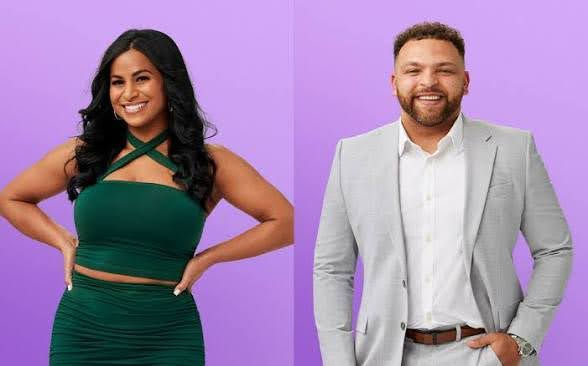
Devonta Anderson, a biracial Black contestant, became engaged to Brittany Wicker, a 33-year-old nurse who identifies as Black and Latina. In a post-reveal confessional, Devonta told cameras: "I fell in love with Brittany. It just so happened that she is a woman of color. That's something I've never actually dated, let alone proposed to and engaged to." He described the realization as something that "surprised" him.
The comment immediately reframed their engagement within a broader conversation about preference, desirability, and self-awareness, one that Brittany processed in real time alongside viewers. She later acknowledged to Remezcla that she needed space to sit with the information, particularly once she understood she fell outside his typical dating profile.
From a format perspective, the moment is significant because it surfaced a rarely articulated dynamic on mainstream dating television: a contestant openly acknowledging limited cross-racial dating experience while simultaneously proposing to a woman of color. In a franchise where race has historically operated as subtext, Devonta made it text. The audience response was immediate, and it was not quiet.
Viewers who followed his arc into the Cabo trip might have noted what some described as emotional distance, prompting broader speculation about physical compatibility and internal hesitation. Whether that read is accurate or a function of selective editing is the franchise's oldest unanswerable question, but the conversation it generated is precisely the kind of discourse that drives streaming engagement cycles.
A brief programming interruption:
Not every Season 10 plot twist involved emotional vulnerability or racialized desirability discourse. Contestant Monica Danús was briefly rushed from the set by ambulance after accidentally putting eyelash glue in her eyes. No pods. No proposals. Just a very unfortunate grooming decision under pressure. She was fine, but it served as a useful reminder that even a controlled experiment cannot fully control human error. Love Is Blind remains, in every sense, unscripted.
Devo, Keya, and the Pattern Recognition Problem
Where the season's cultural friction becomes most concentrated is in the combination of Devonta's pod decision and Keya Kellum's triangle storyline.
In the pods, Devonta built a meaningful connection with a Black woman widely praised online for her emotional intelligence and presence. He did not choose her. The internet reaction was pointed, and it was informed by memory.

Viewers were responding to repetition: a Black woman investing emotionally, a Black man hesitating, a departure that gets framed by production as a compatibility issue rather than examined as a pattern. Whether that framing is deliberate or incidental, the franchise has now generated enough seasons for audiences to construct a statistical case. That is a communications and editorial challenge that producers will need to address, not because criticism is always fair, but because perception, in a social-media-driven format, has structural consequences.

Keya's concurrent indecision triangle with Kevan and Tyler extends the theme. One of the season's cleaner analytical observations: made by viewers rather than the show itself- is that indecision, when consistently centered on Black women contestants, stops reading as romantic tension and starts reading as a thesis. Whether the franchise intends that thesis is almost beside the point. The audience is writing it either way.
Keya and Devo: The Reconciliation That Worked
Against that backdrop, the Episode 2 reconciliation between Devo and Keya registered as one of the season's more genuinely affecting moments. Rather than the abrupt exits or unresolved eliminations that have punctuated prior seasons, this exchange marked by apology and mutual acknowledgment offered something less common in the format: accountability without performance.
The moment generated positive viewer sentiment precisely because it felt unscripted in the truest sense. Executive producers across reality franchises have increasingly foregrounded growth narratives as social-platform currency. Here, the payoff was earned rather than engineered, which is a meaningful distinction.
The "Tingly Wingly" Problem: What the Pods Can't Predict
Episode 4 introduced one of the season's most relatable observations, when Brittany noted that pod dating removes the pressure of aesthetic performance, no visual comparison, no physical self-consciousness. It is, she suggested, a kind of freedom. But that freedom has a ceiling.
There is also something worth naming about the environment itself. Like Big Brother or other controlled-setting formats, the pods, and later the shared house create a kind of emotional pressure cooker. Proximity and the absence of ordinary life tend to accelerate feeling. What reads as deep connection inside that container does not always survive contact with the real world, where distraction, history, and habit reassert themselves. That may be exactly why the show calls itself an experiment. The "tingly wingly" feeling contestants describe upon first meeting in person is biochemistry. Emotional intimacy initiates hormonal pathways, with physical attraction can amplify or derail them entirely. Once couples exit the pods, the body joins the experiment whether the format accounts for it or not. That gap between who someone is in conversation and who they are in a room — is where Love Is Blind lives and dies. Ten seasons in, the show still has not found a clean answer for it.
Does the Experiment Hold?
Across Seasons 1 through 9, approximately 30 to 35 couples became engaged. An estimated 8 to 10 marriages remain intact placing the franchise's long-term success rate in the range of 25 to 30 percent.

Among the enduring unions are: Lauren Speed-Hamilton and Cameron Hamilton, Amber Pike and Matt Barnett from Season 1; Brett Brown and Tiffany Pennywell, and Kwame Appiah and Chelsea Griffin from Season 4.
For a televised social experiment, that outcome is neither categorical failure nor fairy tale inevitability. It is selective durability and Season 10 is being evaluated against that historical performance window by an audience that knows the numbers.
Atlanta on the Horizon
As Season 10 unfolds, industry speculation has surfaced around the franchise's next production phase. Netflix has not formally confirmed filming locations for future seasons. However, local industry reports like this from the Atlanta Journal-Constitution indicate that a reality production tentatively linked to Love Is Blind is slated to film at Atlanta Metro Studios in early 2026, with production filings referencing back-to-back seasons under the designation S12/S13.
Atlanta carries symbolic weight for the franchise, it was the original filming location for Season 1, and Georgia's production incentives have made it a consistent destination for unscripted content. A return would represent both a logistical choice and a potentially strategic one: a reset to the city where the experiment began, at a moment when the show's narrative architecture is under its most analytical audience scrutiny to date.
Watch Love is Blind Season 10 on Netflix.
Black Film Wire covers the business, culture, and politics of Black storytelling in film, television, and media. www.blackfilmwire.com


Comments