
BET’s INTERNATIONAL ACT CUT: Reform or Retreat?

A category restructure promised African artists more paths to win at the 2026 BET Awards. Instead, it produced the first total shutout since the modern era began and the numbers say the loss wasn't for lack of firepower.
By Sahndra Fon Dufe

The 26th annual BET Awards were held Sunday, June 28, 2026, at the Peacock Theater in Los Angeles, hosted by comedian and content creator Druski in his first turn behind the podium. The ceremony celebrated achievements across music, television, film, and sports, with Teyana Taylor and hip-hop duo Clipse emerging as the night's biggest individual winners, each taking home three competitive awards. Also honored: Ms. Lauryn Hill, who received the inaugural Living Legend Icon Award, and music executive Sylvia Rhone, who accepted the Ultimate Icon Award.
Awards categories are never just about who wins. They're about which structures get built to house recognition, and what happens when those structures change. For twenty years, BET has run some version of a dedicated international lane Best International Act: Africa, Best International Act: UK, and eventually a unified Best International Act that functioned, whatever its flaws, as a guarantee. Every year since 2018, it produced exactly one thing: an African winner. The category's final year in its old form crowned Ayra Starr in 2025, who beat Tyla, Rema, Black Sherif, and Uncle Waffles, among others, to win, meaning the last guaranteed African winner arrived just twelve months before the guarantee itself disappeared.

How The Category Got Here
BET's international recognition started in 2010, when British grime artist Dizzee Rascal won a single, unified Best International Act award. From 2011 to 2017, the category split into two regional lanes: Best International Act: Africa and Best International Act: UK, a structure that drew real criticism at the time: in 2015, winners in both lanes were reportedly presented their awards backstage in a pre-recorded segment rather than live on air, prompting Nigerian star Yemi Alade to publicly call for the category to be scrapped. Wizkid holds the record for the most wins under that era, taking the Africa prize twice.
In 2018, BET unified the regional categories into a single global Best International Act, explicitly framed as a move to bring African artists onto the main stage rather than keeping them in a side category. Davido won the inaugural unified award, and an African decade followed: Davido, Burna Boy three times, Tems, Burna Boy again, Tyla, and Ayra Starr ten different African winners in eight years. Ayra Starr, the last artist to hold the title before it disappeared, remains the category's final champion and, for now, its last word.
Ayra Starr, the last artist to win BET's Best International Act award, accepting the trophy at the 2025 ceremony the final year the category existed in its dedicated form.
The Restructuring: Who Got Folded In
In 2026, BET removed that guarantee. Tems, Burna Boy, Wizkid & Asake, and Tyla were folded into the main competitive categories instead, going head-to-head with Kehlani, Doechii, Clipse, and Kendrick Lamar rather than each other, as they had in years prior. The stated logic was expansion: more categories, more chances, more integration into the main show rather than a side lane. What it produced was a total shutout, the first time since the category's modern era began that no African artist won anything at all.
How Are BET Winners Actually Chosen?
The mechanism is smaller and less specialized than it might seem. Nominees and winners across most categories are decided by the same body: a BET Voting Academy of roughly 500 industry professionals: executives, journalists, and media figures who vote on everything from Best Group to Video of the Year without the branch-specific structure other major awards use.
Compare that to the Oscars, where over 10,000 members across nineteen specialized branches nominate within their own craft (actors nominate actors, directors nominate directors) before the full membership decides winners. The exception at BET is the Viewers' Choice Award, which is fan-voted directly through BET.com. BET has not issued a detailed public statement explaining why the international category was folded this year specifically, the voting mechanism itself didn't change; what changed was which room African artists were being voted on within.
A Question of Timing
The timing is worth laying out plainly, even without a confirmed causal line. The African retreat didn't start with new leadership, either: BET International, the London-headquartered channel that had carried BET's US content into UK, African, and MENA markets since 2008, had already stopped operating as a linear TV channel in the UK and Ireland back in 2021, folding its content into streaming platforms instead. That context matters for what came next. BET named Louis Carr president in December 2025, succeeding Scott Mills, who had led the network for 23 years - the first change at the very top of BET in over two decades, and one that capped a 39-year career in which Carr had generated billions in ad sales and built out BET's data on Black consumers, widely credited as the largest of any media company in the world. Weeks into his tenure, on January 1, 2026, Paramount shut down BET Africa entirely, pulling the channel from DStv across South Africa, Sub-Saharan Africa, and the MENA region as part of a broader restructuring, citing low ratings.

Programming: BET Africa was known for shows like Redemption, Isono, Queendom, and The Real Black Pearl. The Best International Act category was then cut from the BET Awards nominations announced that May. BET and Paramount have not publicly connected these decisions to one another, and there's a real argument that Carr, a sales executive stepping into a leadership role during a company-wide Paramount Skydance restructuring, inherited more of this than he authored. But taken together, the timeline describes a network that had been narrowing its footprint on the continent for years before Carr's appointment, and that continued to do so in his first months at the helm. Whether his next moves reverse that trend or continue it will say more about this era of BET than this year's nominations did.

Carr's own words from the day before the show make the gap harder to ignore. In a pre-show press interview on June 27, he described BET's mission in expansive terms: "We always try to make sure that people understand our journey, our impact and our influence, not just on our community, but on all communities, because we know that that's what Black culture does." It's worth noting what wasn't in that interview: any mention of Africa, BET Africa's closure five months earlier, or the international category change that would play out on stage the very next night. That's not necessarily a smoking gun, press junkets rarely get into programming strategy but it's a small, real data point. The most substantial pre-show platform Carr had that week went to hosting bits and a surprise award tease, not to the continent his network had just pulled back from.
Who’s Actually Investing in Africa?
There 's also a broader irony sitting underneath this. As BET was closing its African channel ( DStv Channel 129) and folding its African award category into the main race, Netflix spent the same stretch of 2026 doing the opposite picking up South Africa's "The Four of Us" on the strength of "The Polygamist's" global run, and continuing to invest in African originals more broadly. Neither platform owes African audiences anything by default, and a streamer's acquisition strategy isn't the same thing as an awards show's category structure. But it's a strange moment for the network built explicitly for Black audiences to be pulling back on the continent at the same time a platform with no particular cultural mandate is leaning in. Whether that gap says something about where the industry's attention is actually headed, or just reflects two companies making two different bets, is the kind of question worth revisiting once BET's next moves are clearer.
It's worth asking plainly: does BET US or BET+ currently air any Africa-produced original series? As of this writing, no the network's current scripted slate (Tyler Perry's The Oval and Sistas, The Ms. Pat Show, BET+'s original film library) is entirely U.S.-produced. The clearest example of African original programming under the BET umbrella, a South African drama called Black Gold, premiered on BET Africa in August 2025: five months before that channel closed for good. When BET Africa shut down, its African-produced content didn't migrate to BET US or BET+. It simply stopped being part of the BET portfolio at all.
That context is what makes this year's awards shutout land differently, not as an isolated bad night, but as one more data point in a year where African visibility on BET, on-screen and on-stage, moved in the same direction.
Why Was the International Category Folded?
The framing from BET and outlets covering the change reads as an equity argument: under the old single-category structure, five or more African and international artists were competing against each other for one shared trophy the same bottleneck still facing shows like the AMAs, where Burna Boy, Rema, Tyla and others are grouped into one "international" bucket with only one possible winner. By moving African artists into the main categories, the logic goes, multiple African artists get a chance at multiple different trophies in a given year rather than all competing for one.
That framing matters because it's the same language the 2018 merger used integration, main-stage visibility, moving away from a segregated lane to justify the opposite outcome. In 2018, folding categories together produced more recognition for African artists, not less, because it happened alongside continued dedicated space. In 2026, folding the category away entirely removed the guarantee without replacing it with anything. What changed wasn't the rhetoric. It was which room African artists were being chosen from within.
BET has not issued a detailed public statement explaining the specific reasoning, and the Voting Academy that determines nominees and winners roughly 500 industry professionals, plus a separately fan-voted Viewers' Choice Award operates under the same rules it always has.
The Numbers: Who Actually Outperformed Whom?
The easy reading of a shutout is that the competition was simply better. The numbers complicate that story considerably.
Kehlani, who beat Tems for Best Female R&B/Pop Artist and beat Tyla for Video of the Year, did have the most dominant chart run of anyone in either field this year "Folded" spent a record 17-plus weeks at No. 1 on Billboard's Mainstream R&B/Hip-Hop Airplay chart, the longest run in that chart's 33-year history, on top of two Grammy wins this cycle. That's a legitimate case.

Doechii, who beat Tems for the BET Her Award, arrived with two Grammy wins of her own and Billboard's 2025 Woman of the Year title, also legitimate. Clipse, who beat Wizkid & Asake for Best Group and beat Burna Boy for Best Collaboration, had the single biggest album-cycle story in hip-hop this year: 118,000 first-week units, the group's best opening since 2002, and five Grammy nominations including Album of the Year.
What Tems, Burna Boy, and Tyla Bring to the Table
None of that is in dispute. What's also not in dispute:
Tems is tied with Burna Boy for the most Billboard Hot 100 entries by any African artist in history, at seven each.
Tems scored her first UK No. 1 this year. She holds two career Grammy wins and more than a billion Spotify streams on a single song.

Burna Boy holds the African record for consecutive years charting on the Hot 100 five straight is the first African artist to headline a U.S. stadium, and, the same week as these awards, took "Dai Dai," his and Shakira's official 2026 World Cup anthem, to No. 1 on a Billboard global chart for the first time in his career.

Tyla arrived already Grammy-winning and Hot 100-charting before she ever stepped on the BET stage.

This wasn't a case of underqualified nominees padding a diversity slate. It was five separate races, each decided narrowly, each going the same direction. When that happens once, it's a result. When it happens across every single category African artists were nominated in, in the first year a decades-old guarantee was removed, it's a pattern worth naming.
Who Won Instead: A Category-By-Category Breakdown

The Pattern: Integration Without Guarantee
There's a version of this story where the restructuring is genuinely progressive and this year is simply an outlier, a bad break in a system that will average out over time. There's another version where removing a dedicated category without any transitional protection was always going to produce this outcome in a year when the main categories happened to be unusually stacked, and BET either didn't anticipate that or didn't consider it disqualifying.
Teyana Taylor and Janet Jackson King Moore (L-R) Tems, Doja Cat and Lizzo Ice Cube Teyana Taylor Tems, Doja Cat Keke Palmer (L-R) Marsai Martin and Cardi B (L-R) Lizzo and Tems (L-R) Luke James and Jacob Latimore (L-R) Erica Campbell and Le'Andria Johnson Nia Long
Swipe for BET Awards 2026 Slideshow Backstage Photos | By Bennett Raglin/Getty Images for BET)
Both versions can be true at once, and that's the uncomfortable part. Integration into main categories is, in principle, exactly what African artists and their advocates have asked for real competition, not a separate-but-equal lane. But principle and mechanism aren't the same thing. A dedicated category didn't just symbolically honor African music; it functionally guaranteed a specific, countable outcome every year. Removing it in favor of "equal competition" only works as advertised if the main categories are actually structured to let African artists win at a comparable rate to the guarantee they gave up. This year, that rate was zero.
The Night’s Other Iconic Moments
Druski's Hilarious Crowd Moment With Keke Palmer & Ray J | BET Awards '26
The shutout wasn't the only story of the evening, and it's worth separating the category outcome from everything else BET got right. Keke Palmer delivered the most talked-about unscripted moment of the night, taking the microphone from host Druski mid-show and declaring "This should have been my gig" before smoothly introducing Cardi B's performance herself, a moment with real teeth given she'd just joined BET's Board of Advisors and had never been given an actual hosting credit despite headlining the VMAs, the Soul Train Awards, and this year's Billboard Women in Music ceremony.

Janet Jackson surprised Teyana Taylor with the inaugural Icon of the Year Award, and Taylor went on to have the biggest individual night of any winner, taking three competitive awards on top of the Icon honor.
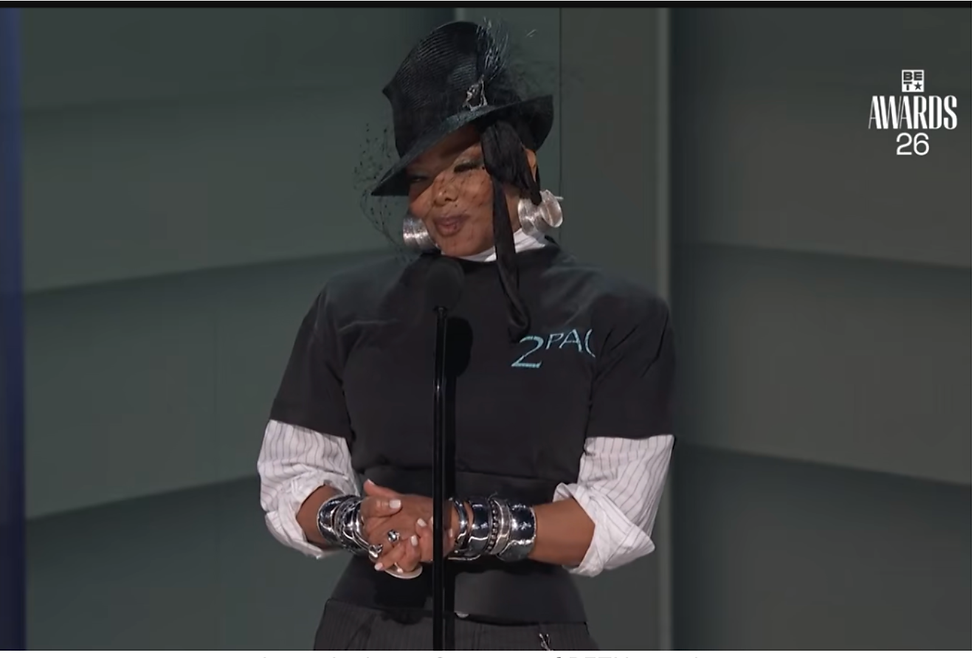
JANET JACKSON at The BET Awards 2026 | Source: BET Networks
The Ms. Lauryn Hill tribute was the emotional center of the show, a sprawling, career-spanning medley featuring Doechii and SZA, Tems and Tierra Whack, Doja Cat and Nas, and rising singer Alexia Jayy on "Killing Me Softly," before Hill herself closed with a surprise live rendition of "Ex-Factor."
Lauryn Hill Performs "Ex-Factor" in an Unforgettable Living Legend Moment | BET Awards '26
Tems, notably, closed the night in a custom chocolate-brown Luis De Javier gown, styled by Dunsin Wright, one of the sharpest looks of the evening, on a stage where she didn't take home a single trophy.
BFW Take: What This Means Going Forward
The version of this story BET will likely tell is that this was a one-year anomaly inside a fundamentally fairer system. That's a defensible position, and it may even prove true next year. But defensible isn't the same as demonstrated, and the burden of proof now sits with BET, not with the artists who lost. If the 2027 ceremony produces another shutout, "unusually stacked competition" stops being a plausible explanation and starts looking like a structural feature of a category change that removed a guarantee without replacing it with anything. The next twelve months of nominations, and whether BET quietly reinstates some version of dedicated recognition will tell us which version of this story is actually true.
BET didn't take anything away from African artists on paper. Tems, Burna Boy, Wizkid, Asake, and Tyla were all still in the room. But being in the room isn't the same as being counted on to win in it, and this year, for the first time in nearly a decade, they weren't.
Missed it? The full 2026 BET Awards ceremony is now streaming on demand on Paramount+.


Comments