
CAMIFF 2026 Masterclasses Deepen Industry Skills Across Directing, Acting, Cinematography, and Screenwriting
Updated: Apr 30
Day Two of CAMIFF’s training programme brings together emerging filmmakers across four simultaneous masterclasses, blending technical instruction, creative development, and cultural exchange to strengthen the next generation of African storytellers.
Day 2 of CAMIFF Master Classes involved four different Master Classes on Directing, Scripting Writing, Cinematography, and Acting which were happening simultaneously.

Directing Master Class
The directing class was taken by Cameroonian renowned director Enah Johnscott.
The directing session focused on the foundational role of intention and preparation in directing, beginning with the facilitator’s emphasis on the careful use of language and the importance of framing every scene from a place of conflict.
Participants were introduced to the concept of the “core self,” defined as the unchanging essence of a character that drives behavior, dialogue, and decision-making throughout a story. The facilitator highlighted how effective directing relies on guiding actors from this internal truth rather than giving surface-level instructions.
The discussion then moved into the technical framework of directing, with a detailed exploration of script breakdown. Described as a critical pre-production process, breakdown involves analyzing a script scene by scene to identify creative, technical, and logistical requirements.
The session also examined visual language in film, including the use of colour and camera angles to communicate meaning, emotion, and perspective. Through a practical case study of a dramatic confrontation scene, participants were guided through the process of identifying objectives, emotional beats, tone, and technical execution.
The class concluded with a strong emphasis on preparation, reinforcing that effective directing begins long before arriving on set, with thorough breakdown ensuring clarity, efficiency, and alignment across the entire production team.
Cinematography Masterclass
The cinematography masterclass was led by Rene Ettat and Takong Delvis, offering participants a balanced approach to both technical fundamentals and visual storytelling.
Rene Ettat opened the session with a focus on camera basics, guiding participants through key concepts such as aperture, focal points, and controlling light and depth of field. He emphasized the importance of understanding the camera as a tool for shaping visual language and meaning.
Building on this foundation, Takong Delvis shifted the focus to visual storytelling, exploring how images convey emotion and narrative. Using a simple scenario of a lone boy seated in a classroom, he challenged participants to consider how framing and shot selection can communicate isolation and mood.

The session progressed into shot composition and perspective, introducing key techniques such as bird’s-eye, low-angle, high-angle, and eye-level shots, each influencing how audiences perceive characters and scenes. Delvis stressed the need for variation to avoid visual monotony.
Camera movement was also examined, including tracking, panning, tilting, and static shots, with emphasis on using each intentionally to support storytelling. He further highlighted composition as a critical skill, noting that subject placement within a frame must always serve the narrative.
The session concluded with reflections from both facilitators, who shared practical on-set experiences while addressing the professional and ethical responsibilities of cinematographers, particularly in navigating collaboration and creative dynamics with directors.
Acting Masterclass
The acting masterclass deepened participants’ training with a focus on voice, confidence, and performance. Led by actor and trainer Song Nestor, the session revisited foundational voice and body exercises, reinforcing presence, projection, and self-assurance.
The class then moved into monologue development, with participants divided into groups to create and perform original pieces. The exercise encouraged collaboration, creativity, and practical application of characterisation and delivery.
Guest speakers Prisma James and Simplest Ntuiti added real-world insight, sharing experiences on discipline, consistency, and navigating the film industry.

The session concluded with group performances, offering participants an opportunity to showcase their work and receive feedback, marking a dynamic and engaging continuation of the masterclass programme.
Screenwriting Masterclass
The screenwriting masterclass for the day was led by Cameroonian screenwriter and producer Buh Melvin. He focused on the fundamentals of cinematic storytelling, with particular emphasis on story structure and character development through Joseph Campbell’s Hero’s Journey.
Grounding theory in local context, Melvin drew on films such as The Fisherman’s Diary and Half Heaven to illustrate the protagonist’s transformative arc, using selected scenes to break down key stages of the journey. Central to his approach was a clear objective: the writer’s responsibility to make the audience care deeply about the character.
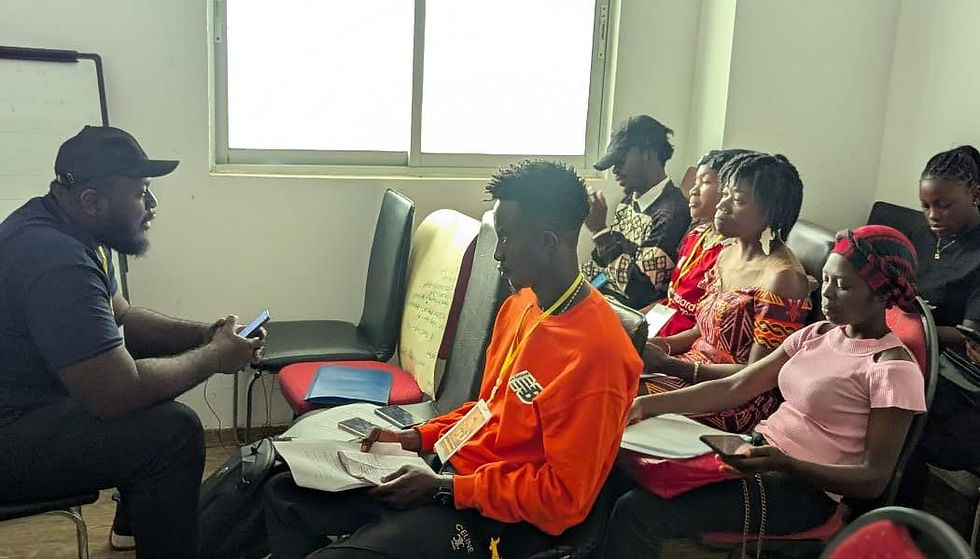
The session evolved into an interactive workshop, with participants actively engaging in exercises designed to test their understanding. One such activity challenged students to classify phrases within the 12 stages of the Hero’s Journey, reinforcing both structure and narrative logic.
Building on this momentum, participants moved into a collaborative brainstorming session, generating story ideas for a CAMIFF project to be developed entirely by the masterclass cohort. The exercise fostered a strong sense of creative exchange, as emerging writers contributed concepts with the potential to evolve into future screen productions.
CAMIFF Cultural Night
The day concluded with a vibrant cultural night, as actors, comedians, content creators, and filmmakers including Prisma James, Takong Elvis, Sahndra Fon Dufe, Rosine Nguemgaing, Nigerian Filmmakers Ruth Kadiri and Ramsey Nouah all appeared in regal traditional attire, celebrating the richness and diversity of Cameroon’s cultural heritage.

As CAMIFF 2026 continues, the Day Two masterclasses underscored the festival’s commitment to nurturing talent and strengthening the foundations of African cinema. By bringing together directing, cinematography, acting, and screenwriting in one immersive learning environment, the programme not only equipped participants with practical skills but also fostered collaboration, critical thinking, and creative exchange.


Comments