
Mirrors and Reflections Review: Bold, Fashionable, and Not Quite As Deep As It Thinks

Updated: Apr 10
Bimbo Ademoye's latest YouTube film arrives with 8 million views, a standout supporting cast, and serious style — but does the dual performance at its centre fully deliver?
Atlanta, GA April 9, 2026

★★★½ / 5 | 7/10 Rated on: Story & Script, Lead Performance, Supporting Performances, Direction, Production Design, and
Emotional Impact
Directed by Great Val Edochie | Written by Ukeme Ninedeys | Produced by Grace Felix | Executive Producer: Bimbo Ademoye | A3 Studios | 2h 13 mins | Now streaming free on Bimbo Ademoye TV, YouTube
Eight million views in six days. By any measure, that is a number that commands attention. Mirrors and Reflections, the latest production from Bimbo Ademoye TV, arrived on Good Friday, April 3, 2026, and promptly did what Bimbo Ademoye productions have come to do reliably: pull a crowd. Whether the film earns all eight million of those views critically is a different, and more interesting, question.

It also arrived with a small storm swirling around it. In the days before release, an AI-generated TikTok post went viral, accusing Ademoye of a pattern, emotional livestreams timed to new releases, the suggestion that the tears are a PR strategy rather than a genuine window into her process. Ademoye went live to respond directly, detailing a production period that included a fire on set, a near-miss accident involving her personal assistant, a channel demonetisation battle, and a legal dispute still active in court. Whether you find the timing of her candour convenient or completely understandable likely says more about your prior relationship with her work than it does about her. What is fair to say is this: the noise did not hurt the numbers, and it did not hurt the film. Both exist independently. We are here to talk about the film.
The Setup
Mirror twins Ifeoluwa and Ifedayo, both played by Ademoye, are inseparable growing up but could not be more different in temperament. Ifedayo is disciplined, left-handed, black-coffee-no-sugar, and destined for legal greatness. Ifeoluwa is a free spirit: right-handed, loads of creamer, bags tossed in the front seat, energy first and consequences later. After years apart, Ifeoluwa returns from the UK and convinces her sister to sneak out for one reckless night. A car accident claims Ifedayo. Guilt-ridden and adrift, Ifeoluwa makes a decision the film treats as daring and that most sensible viewers will find somewhere between morbid and genuinely unhinged: she moves into her dead sister's apartment, shows up at her prestigious law firm, and starts living her life.

The inciting incident that seals the decision is one of the film's funniest scenes. Ifeoluwa attempts to change a hundred-dollar bill with a Hausa money changer on the street, and he tries to cheat her. Spectacularly. The chaos that follows is the kind of scandalously funny, painfully real Nigerian street comedy that lands because everyone in the audience has either witnessed it or lived it. It is also precisely the moment a colleague from the firm happens to spot her from across the way, rescues her from the situation, and delivers the line that changes everything: everyone is looking for you at work. You haven't been in, in a while. Just like that, she has no more excuses. The life is waiting. She walks into it.
The premise itself is not without precedent. Ramsey Nouah navigated a twin identity swap in Tade Ogidan's Dangerous Twins (2004), a film that sold millions of copies and became a landmark of its era. More recently, Ryan Coogler's Sinners (2025) showed what a director at full command of his material can do when characters literally reckon with a version of themselves. Netflix's long-running The Lying Game built an entire series on the psychological tension of a stolen identity. The standard has been set. The question is whether Mirrors and Reflections meets it.
Partially.

Another scene from Mirrors and Reflections Movie
What the Film Gets Right
Sonia Uche, playing Ihuoma the fiercely loyal best friend, is quietly this film's most consistent performer. The moment she catches on, Ifedayo used her left hand; this one uses her right. Ifedayo took her coffee black; this one wants creamer. Ifedayo would never fling her bag onto the front seat; this one does it without thinking, is among the film's most satisfying stretches of storytelling. These are behavioural tells. No dialogue required. The film earns that scene properly.
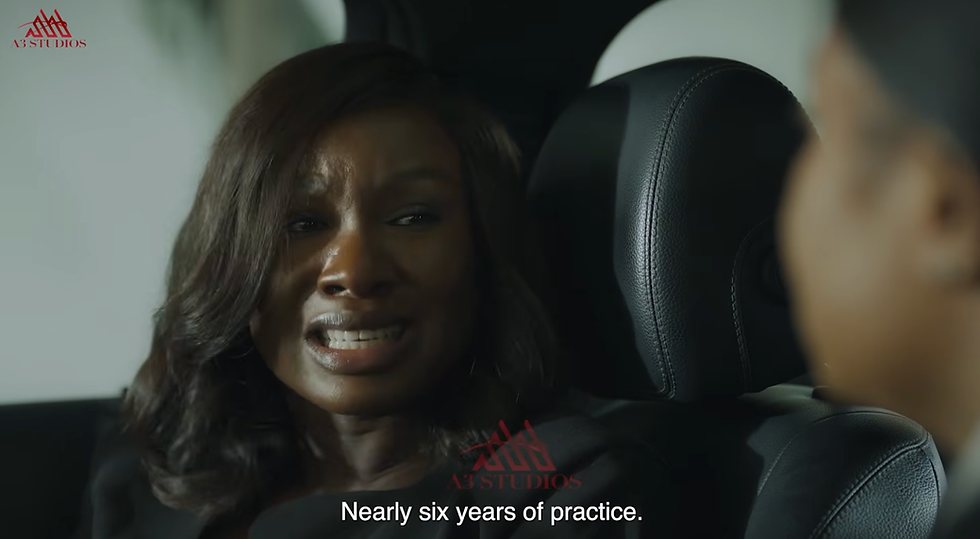
Uche's confrontation that follows, your sister was a great person, you've always been selfish, you should have given us a chance to mourn her, is the most gripping in the film. She brings moral clarity and emotional precision to a role that could easily tip into sidekick. Instead, she co-anchors the story. What is even more impressive is what comes next: Ihuoma reverses course the very next day, returning not to scold but to say: your sister's goal was for you to stop running. Stay. Do this thing. That quiet pivot is beautifully played and it sets up one of the film's most quietly powerful themes: the importance of a friend who sharpens you.
When Ifeoluwa eventually stands in that courtroom and makes her case with precision and calm, arguing successfully that her client Kola Adeyemi is not a flight risk, she does so partly because Ihuoma sat with her the night before and drilled her until she was ready. That is what real friendship looks like on screen, and the film honours it.
And then there is Mama Ibeji.
The role is played by Vivian Ngozi Metchie. Remember that name. Her performance is raw without being theatrical, grief-stricken without dissolving into melodrama. The scene where she arrives at the law firm and barely holds herself together is, quietly, the finest single acting moment in the entire film. One YouTube commenter captured it simply: "This woman who acted as their mother deserves recognition... you could feel her pain and still see it in her eyes. We need to see more of her." The entire comment section reached the same conclusion independently.

Ademoye herself weighed in thoughtfully, posing a question to audiences worth sitting with: "Do you think Mama Ibeji had a hand to play in Ifeoluwa running away from her problems? The constant comparison to Ifedayo?" Another viewer responded with something that stayed with me: "Grief can make you say the worst things. I know someone this happened to, his mother lost her only daughter and said God should have taken one of the sons instead." That is the kind of real-world resonance a film earns when it writes its supporting characters with enough honesty to make them complicated. Metchie delivers that complexity in full.
Now, Mr. Awade, played by the effortlessly funny Layi Wasabi. The bald-headed colleague who had a quiet but obvious thing for the late Ifedayo is one of the film's most delightful comic presences.

When Ifeoluwa clocks him staring at her with an intensity that has no business being that focused, she turns to Ihuoma and asks, with complete seriousness: "Who is that bald-headed man and why is he looking at me like junk food?" The audience was gone. What makes the joke land even harder once you have the context is the revelation that Mr. Awade was the deceased Ifedayo's own secret admirer, meaning Ifeoluwa has unwittingly inherited an entire situation she did not sign up for. When she eventually connects those dots, she turns to her best friend and delivers what is, genuinely, the funniest line in the entire film: "Is there a way you can call heaven? I need to ask my sister some serious questions."
What is worth noting, and what the film deserves credit for, is that Mr. Awade is actually the one who eventually sees through the impersonation. The person who has been quietly studying Ifedayo for the longest time is the one who notices that something fundamental has shifted. That is a thoughtful storytelling choice. The bald head is the comic relief, but the discernment underneath it is doing real narrative work.
On the romantic front, Femi Adeyemi, played by the heartthrob Edo actor Clinton Joshua, whose easy charm fits the role well, is the other man in the picture. A colleague and, as it turns out, the cousin of Kola Adeyemi, the very client Ifeoluwa is working to defend on a murder charge. He quotes poetry, matches her energy, and their scenes together genuinely spark. The film earns its warmth in those moments.

The film also rewards viewers who come in curious about Nigerian law. I studied law as an undergraduate, and I came to Mirrors and Reflections with genuine interest in what it would teach. The experience reminded me of how Suits made entire generations fluent in depositions and the tactical architecture of discovery and motions. How Grey's Anatomy had us all using attending, intubation, and code blue years before we needed to. How How to Get Away with Murder made immunity deals and the limits of attorney-client privilege feel urgent and personal. Mirrors and Reflections operates on a smaller but worthwhile scale: it walks viewers through bail conditions, the weight of the judge's stipulations, and what a flight risk argument looks and feels like in what appears to be a High Court-level civil proceeding. When Ifeoluwa makes her argument, calmly and point by point, it lands. It is the kind of scene that makes you feel like you have learned something by the time the credits roll.

The AI plot device is the most original element in the script. Ihuoma's daughter's school project ultimately cracks the case by detecting light-source inconsistencies in digitally manipulated photographs, evidence that had been weaponised against the client. It is contemporary, logical, and uses technology as a storytelling tool rather than a shortcut. In a legal landscape increasingly grappling with synthetic evidence, it feels genuinely current.
And the fashion deserves its own paragraph. Mirrors and Reflections is one of the most visually styled Nollywood productions in recent memory, and the styling is doing active character work. When we first encounter Ifedayo, her wardrobe is what you might charitably call functional. Conservative. Fine, but firmly in the background. The moment Ifeoluwa steps into that life, everything changes. The costuming largely courtesy of Lagos-based label @ariellight_official, becomes a full character statement. Monochrome head-to-toe. Structured suiting. Power shoulders. The kind of Kim K-level sartorial precision that announces a woman before she opens her mouth. The transformation from who Ifedayo was to who Ifeoluwa becomes is communicated as much through the wardrobe as through anything else. When her boss pulls her aside to say this is not a fashion show, and she responds, not missing a beat: everything is covered, if I'm breaking the law, let me know. Correctly said. There is also a cheerful product placement cameo from Winston Leather bags and a road trip logistics brand that earns a smile precisely because it is so unapologetically inserted. Local. Proud. Shameless in the best possible way.


Then there is foineeeeee Sunshine. She spends most of the film being precisely what she is: a hater with good taste and sharp edges. When Ifeoluwa clocks her in the corridor, cheap bag and all and shuts down the sneering without breaking stride, it is deeply satisfying. But what is more satisfying and what most writers would not have done, is that by the film's end, Sunshine is the one initiating lunch. No grand confrontation. No apology speech. Just two women deciding to try. That quiet resolution is more emotionally mature than most films of this kind manage, and it deserves to be named as one of the better creative choices in the script.

Where It Falls Short
Here is the point that needs to be said clearly: Bimbo Ademoye does not fully separate the twins. The problem is not just that the distinctions remain surface-level, it is that they remain largely tied to dialogue and wardrobe rather than something we feel in the body of the performance. We are told who is who more than we are made to feel it.
Compare that to Michael B. Jordan in Sinners, where every version of himself carries a different gravitational weight, the same body, genuinely different souls. Or Lupita Nyong'o in Us, where the duality is terrifying precisely because you sense the same intelligence operating through entirely different emotional architectures. Even Ramsey Nouah in Dangerous Twins (2004) a straight-to-video era production with a fraction of this film's resources, made Taiye and Kehinde feel like men who happened to share a face, not variations on a single performance. The challenge of playing twins is, at its core, a challenge of interiority. The physical tells matter. But what matters more is whether we feel two distinct people even when the camera is not using split-screen to remind us.

This is not a statement about Ademoye's ceiling as an actress. Broken Hallelujah (2025), opposite Daniel Etim Effiong — 11 million views — remains one of her most emotionally excavated performances to date, and many viewers and critics continue to regard it as the benchmark her more recent work is measured against. Where Love Lives (21 million views in three months) and Miles Away from Home with Timini Egbuson (9.8 million views in four months) show her commanding entirely different registers with ease. Mirrors and Reflections asked for something harder. On that specific ask, it asked for more than it received.

Blake Snyder writes in Save the Cat: "Danger must be present danger. Stakes must be stakes for people we care about. And what might happen to them must be shown from the get-go." The principle extends beyond danger, it extends to character. We should be able to feel what is at stake for these two women, not just be informed of their differences through exposition and a wardrobe change. The film's indoor staging compounds the problem. This is a legal thriller built around gathering evidence on a morally dubious client, a story crying out for at least one sequence of Ifeoluwa and Ihuoma actually doing the legwork. Stakeouts. Surveillance. A moment of physical risk outside four walls. The PI character exists, gestures toward this, and disappears. The audience wanted to go with him.
The Plot Takes Some Losses
When Ihuoma discovers the impersonation, her ultimatum feels dramatically satisfying in the room: leave the apartment, leave the firm, by Sunday. But the lawyer in me could not let it go. Ifeoluwa is next of kin. The apartment almost certainly reverts to family, not to a best friend, however beloved. The firm? Perhaps a reasonable request. The home? That ultimatum has no legal standing, and the script does not seem to know it. The plot takes a quiet loss there.

There is also the scene where Ifeoluwa mentions a concussion and two senior partners, played by Osas Ighodaro and Layi Wasabi immediately pivot back to client business as though she announced a scheduling conflict. Not a single are you alright. Not even the cold pragmatism of a liability-conscious partner offering minimal concern before moving on. Characters can be self-absorbed. Characters can be cruel. But the scene lands as a script oversight rather than a deliberate character choice, and it briefly pulls you out of an otherwise convincing world.
As for Femi, he is charming, he is present, and the chemistry is real. But he never figures out that she is not who she says she is, while Mr. Awade catches on quietly. By the end, the film is asking us to invest in a relationship with a man whose emotional antennae were pointed entirely at chemistry rather than at the person standing in front of him. I just wished the film had slowed down long enough to make sure we trusted him before asking us to love him.

The Numbers and What They Mean
What Mirrors and Reflections confirms, even with its limitations, is that digital-first Nollywood is not a phase, it is the industry. Uche Montana's Monica opened to 13 million views in two weeks in March 2026. Omoni Oboli's Love in Every Word hit 11 million views in its first seven days in 2025 before surpassing 20 million within three weeks. BamBam and Uzor Arukwe's Love in Other Words sits at 31 million views. These are rockstar numbers. At a conservative RPM of $0.20–$0.50 per 1,000 views, the realistic range for Nollywood content drawing primarily African audiences with strong diaspora crossover, a film at 8 million views is generating between $1,600 and $4,000 in ad revenue alone, before brand deals, licensing, and the compounding long-tail value of a 1.38 million-subscriber base. The economics of independent Nollywood have quietly become very serious business.
One commenter put the film's real achievement plainly: "Finally a movie that's not 'man meets girl, they fight, then make out, then realize they are in love.' Thank you for this. It was such a refreshing watch." That is both a genuine compliment to Mirrors and Reflections and a diagnosis of the bar it cleared. The film is better than average. It is funny in the right places, emotionally honest in the places that matter most, and technically ambitious in ways that deserve recognition. It is not yet as complete as its ambition suggests it wants to be but the foundation is strong, the supporting cast is exceptional, and the call to go deeper is not a criticism so much as an invitation.
Vivian Ngozi Metchie proved what is possible in a supporting role. Sonia Uche confirmed it in a best friend arc. The infrastructure exists. The question now is whether the next production reaches for what this one gestured at and stopped just short of.
Black Film Wire's Movie of the Month.
Mirrors and Reflections is streaming free on Bimbo Ademoye TV, YouTube.


Comments