
Tomi Adeyemi, Amandla Stenberg and What the Children of Blood and Bone Debate Means for Black Fantasy’s Next Decade

Updated: Jul 23
Six months before Children of Blood and Bone opens in theaters, its author tells the world she won't be watching it
By Sahndra Fon Dufe

On July 4, Tomi Adeyemi, the Nigerian-American writer whose 2018 debut spent 175 combined weeks on the New York Times bestseller list across its trilogy posted a TikTok that split her fandom in half. In it, she revealed she's stepping back entirely from Paramount's adaptation of her own book: no promotion, no premiere, no viewing. She encouraged fans who want to support her to buy the novels from independent bookstores instead. Buried in the same video was something more explosive- a screenshot showing she'd cut off contact with her film's lead actress, Amandla Stenberg, back in February 2025.
This is not a case of a writer watching helplessly as Hollywood mangles her work from a distance. Adeyemi co-wrote the screenplay. She's credited as an executive producer. Her fight to get the writing job was, by her own studio's account, a non-negotiable term of the deal. Which makes her decision to publicly disown the finished film genuinely unusual — and worth understanding on its own terms, not just as internet drama.
What we actually know
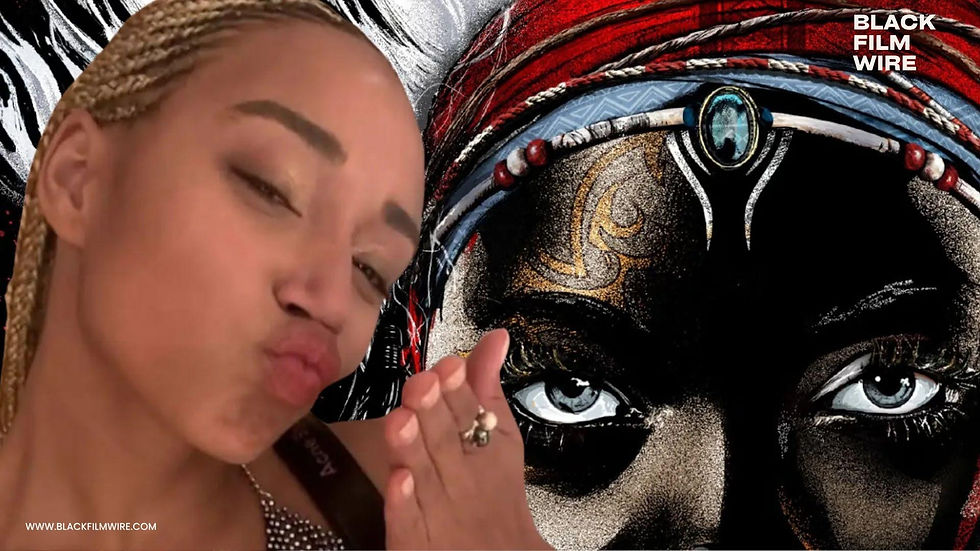
The film has been carrying tension since casting was announced in early 2025. Thuso Mbedu was cast as protagonist Zélie, and Amandla Stenberg, a biracial actress best known for The Hunger Games and The Hate U Give was cast as Princess Amari, the king's daughter. In the novel, Amari is described as having a "copper complexion," and colorism is central to her arc: her own mother pressures her to lighten her skin, and she's told directly that she's "far too dark." Fans expected the casting to reflect that. Stenberg's casting didn't, and the backlash was immediate.

Copper, in modern usage, describes a medium-brown skin tone with warm, reddish undertones, historically a term used by European explorers and anthropologists to describe Indigenous peoples before it entered broader color vocabulary. Whether Stenberg's complexion technically qualifies is genuinely debatable and probably beside the point.

The sharper version of the fan critique isn't about a strict color match, it's that a story using colorism as an allegory for racism cast an actress who, by her own account, hasn't experienced that particular form of marginalization the way darker-skinned Black women have. Stenberg addressed this herself in February 2025, saying she thinks about her skin tone with every role she takes and that she believes it "serves the story in supporting the allegory of colorism."
Adeyemi initially defended the casting publicly and pointed fans toward an open casting call in Nigeria as reassurance that the production was serious about representation. When those results landed: two relative newcomers alongside two already-established stars. Many felt it didn't live up to the buildup, given how much had been made of the call.
Then came the private unraveling. According to Stenberg's own account (in a TikTok she has since deleted), she and Adeyemi had an emotional dinner conversation in which Adeyemi told her that the racist backlash Stenberg faced as a child playing Rue in The Hunger Games had partly inspired her to write a series where Black girls of every shade could see themselves. Stenberg has said this conversation is part of what convinced her the role was hers to take. Weeks after Stenberg referenced that conversation publicly to defend her casting, Adeyemi sent her a message: "Do not ever use my name in an interview or video again. Do not text me. Do not call me." She then blocked her.
What happened in between, what actually caused the break …. has never been explained. Adeyemi has only offered fragments: that she's been "hurt and attacked behind the scenes," and, in a separate post, a cryptic line about how being a "young gifted child" in Hollywood, compounded by "dark skin and natural hair," invites people who want to "destroy you." No specifics. No named grievance. Paramount, Gina Prince-Bythewood (her co-writer and the film's director), and the cast have all stayed silent.
Why this is bigger than one feud
Here's what separates this from ordinary celebrity drama: the margins for error in this specific lane of the industry are razor thin, and the numbers explain why. Black authors made up 7.2% of YA titles published in 2022, according to the Cooperative Children's Book Center, up from 3.3% in 2014, real progress, but still a sliver. Zoom out further: 89% of books acquired by the Big Five publishers in 2022 had white authors. A fantasy adaptation that makes it all the way to a $100-million-plus theatrical release, written and co-produced by the original Black author, is not a category with room to spare. There's no deep bench of comparable projects quietly absorbing the loss if this one goes sideways in public, there's this film, and whatever comes after it, watching.

That scarcity is exactly why the "next Black Panther" comparison keeps surfacing around this project, and it's worth taking seriously rather than treating it as hype-speak. Black Panther's 2018 success didn't just make Marvel money, it gave the entire industry confidence to fund a wave of Black-led properties that came after it, some of which succeeded and some of which didn't. That's the actual mechanism: one high-visibility win reshapes what gets greenlit for years. The inverse is just as true, and arguably more durable in the industry's memory. Children of Blood and Bone was positioned, explicitly, as fantasy's version of that moment. A messy, unresolved authorship rift landing six months before release doesn't need to sink the box office to do damage, it just needs to become the story a studio executive remembers the next time a debut Black fantasy novelist asks for a screenplay credit of her own.
Cryptic, not silent: The gap between hurt and explanation
It's a fair question, and the likely answer is that these two things aren't actually in tension. NDAs on studio productions typically cover specific contractual and creative details: what was said in meetings, why scenes were cut, the terms of a dispute. They don't usually prevent someone from saying that they're hurt or that a relationship has ended, only from saying why, specifically. Adeyemi's posts thread that needle carefully: emotional, cryptic, never naming a grievance.
There's a recent, instructive parallel in Justin Baldoni and Blake Lively's fallout over It Ends With Us. Lively filed harassment and retaliation claims against her director and co-star in December 2024; Baldoni countersued for $400 million; most of Lively's claims were dismissed by a judge in April 2026, and she dropped the rest and settled two weeks before trial. Baldoni didn't speak publicly for almost two years "we have not spoken publicly for the better part of the last two years, and it's not because we haven't had anything to say," he said in July 2026, "but it just felt like every time we went to make a video like this, something was telling us not to." Legal exposure can hold people to strategic silence far longer than fans expect, right up until a settlement or a book release, in Adeyemi's case changes the calculus.
The other rift: Nigeria
There's a second controversy running underneath the Adeyemi-Stenberg story that's gotten less attention outside Black and Nigerian media, and it deserves its own spotlight: this was never purely a Black-American colorism story. It's also a story about who gets to represent Yoruba culture on screen.

Of the confirmed Nigerian-connected cast members, several are UK-based rather than Nigeria-based, and prominent Nollywood names actors with decades of legitimate star power in Nigerian cinema were largely passed over. Nigerian commentators on BookTok have pointed out that the novel's own language isn't linguistically accurate to Yoruba; one commentator flagged that the protagonist's name, Zélie, uses a letter that doesn't appear in the Yoruba alphabet at all. The broader argument some Nigerian critics have made is that the book and now the film was never really made for a Nigerian audience. It's diaspora storytelling, filtered through a Western industry, for a Western audience, using Yoruba iconography as texture rather than as the intended audience's own story reflected back to them.

This is a genuinely separate fault line from the Amari casting debate, and conflating the two flattens something important. One is about which shade of Black gets to represent oppression on screen. The other is about which nation's Black creatives get access to tell a story rooted in their specific culture at all. Reasonable critics disagree on both and, tellingly, some Nigerian commentators have pointed out that Nollywood itself hasn't yet built the infrastructure to compete for these roles on the world stage, making this less a simple story of exclusion and more a harder conversation about where investment and infrastructure actually sit.
How The Internet is Arguing About This
Scroll through any thread on this and you'll find the same core disagreement dressed up a dozen different ways, and it's worth untangling because one side of it is doing more actual argumentative work than the other.
The most common pushback goes something like: if it's fine to cast a Black actress as a Greek queen, why isn't it fine to cast a lighter-skinned Black actress as a darker-skinned Black character? It's a rhetorically tidy "gotcha," and it's also not really analogous. Race-blind casting for a role where race isn't written into the plot, Greek queen whose story has nothing to do with skin tone is a different question than casting for a role where skin tone is the entire point. Amari isn't just dark-skinned incidentally; she's dark-skinned as the mechanism of her oppression, mistreated by her own family specifically because of it. Swapping race in a race-irrelevant role and lightening the casting in a role about colorism aren't the same move, even though they sound structurally similar when you say them fast. This isn't a new argument, either, Zoe Saldana's casting as Nina Simone drew nearly identical criticism for exactly this reason, and it's held up as a comparison in serious film criticism, not just internet arguments.

There's also a real irony worth sitting with: the backlash against Stenberg isn't "you're not Black," it's "you're not the specific version of Black this particular story is about." That distinction gets lost fast online, where it collapses into simpler, angrier shorthand on both sides.
And one structural point cuts through a lot of the noise, regardless of where you land: actors rarely have final say over their own casting. The decisions get made by executives and producers optimizing for marketability, and the actor who says yes to the job absorbs the backlash for a choice they didn't structurally control. That doesn't erase the legitimate criticism of the casting itself, but it's worth remembering who actually has the power in these decisions, and who doesn't.
This isn't the first author to walk away, but it is a rare shape of walking away
Authors disowning adaptations is a genre unto itself. Roald Dahl was "infuriated" by Willy Wonka & the Chocolate Factory and considered publicly campaigning against it. P.L. Travers reportedly cried at the Mary Poppins premiere over how her story had been softened. Michael Ende called The NeverEnding Story a "gigantic melodrama of kitsch, commerce, plush and plastic" after seeing the script only days before release.
What all of those have in common is that none of those authors wrote the screenplay. They were bystanders to their own adaptations, protesting decisions made entirely without them. Adeyemi's case is structurally different, she had the pen. Rick Riordan is probably the closest precedent: he publicly criticized the early 2010s Percy Jackson films for straying from his books, but even he didn't have a screenplay credit until years later, on Disney+'s series adaptation. A credited co-writer and executive producer disowning her own finished film, mid-cycle, months before release, is genuinely rare in the historical record.

Where this leaves us
We'll say this plainly, as a platform that writes inside this genre and spends its working life moving between the rooms where these decisions get made: we don't know what happened between Adeyemi and Stenberg, and we're not convinced anyone outside that relationship ever will, at least for a while. But we don't think that's actually the most important question here.
As writers, we believe stewarding your project to the best of your ability, through to the end is part of the job, especially once you've taken on the title of executive producer and screenwriter and not just source material. Adeyemi owns the rights to her book outright. She could have declined to promote the film and left it there. She could have written a single line “we didn't handle this the best way, and I'm stepping back”- and let it rest. Instead, what fans got was a screenshot war with no resolution and no named grievance, and that choice has consequences that extend well past her, for the reasons laid out above.

None of that means Adeyemi is wrong. She could end up being completely right about whatever drove her to block Stenberg and step back, and it still might not change the outcome for the writers coming up behind her. That's the part we don't think enough people are sitting with. Being a pioneer being one of the first people trusted with this level of access comes with a responsibility to think about who's watching and what precedent you're setting, not because you owe anyone your silence about real harm, but because the sector you're operating in doesn't have the depth yet to absorb a bad outcome without everyone behind you paying some part of the cost. Life is something you have to look at from ahead, not just from behind.
You have to weigh a decision like this by where it leads eventually, not just by how it feels in a season
We say that with real love and real support for Adeyemi and her work. We just don't know, yet, if this was the best way to do it.
Children of Blood and Bone opens in theaters January 15, 2027. Adeyemi's next novel, The Siren, arrives September 29, 2026, support her directly by ordering from your local independent bookstore.
Suggested Reading


Comments